Guide ·
Custom Printed Poly Bags vs. Stock Bags: Which Is Right for Your Business?
Every business that packs in poly bags reaches the same fork: keep buying stock bags off the shelf, or have custom printed poly bags made to your spec. Here is how the two compare on fit, branding, performance and real cost, and how to tell when it is time to switch.
Stock bags and custom bags: what the words mean
Stock bags are made in standard sizes and gauges and sit in a distributor's warehouse until someone orders them. They are usually clear or plain white, with no printing, and you pick the closest size from a catalog. You can order a case today and have it this week.
Custom poly bags are made for one customer. You choose the width, length and gusset, the film, the thickness and the features, and the bag is printed with your artwork. A custom bag is produced as its own run, so it takes planning, but every bag that comes off the line is built around your product and your brand.
Neither option is better in the abstract. The right choice depends on your volume, how the bag is used, and how much work the package has to do for you once it leaves your building.
When stock bags make sense
Stock bags are a sensible choice in a few clear situations:
- You are testing a new product and expect the size or contents to change.
- Your quantities are small or unpredictable, and you need bags on short notice.
- The bag is purely protective, such as an inner bag inside a printed box, and no customer ever sees it.
- Your product happens to fit a standard size well, with little wasted film.
The trade-off is that a stock bag does nothing beyond holding the product. If you need branding, ingredients, barcodes or instructions, they go on a sticker, a printed insert or a separate label, and somebody has to apply them by hand or by machine.
When custom printed poly bags pay off
Once a product is established and you buy bags regularly, custom printed poly bags start earning their keep in four ways.
Fit. A bag sized to your product uses less film, packs tighter in a case and looks neater on the shelf. Oversized stock bags leave loose film to fold, tape or trim, and that excess shows.
Branding. The bag becomes the label. Your logo, colors and product name are printed directly on the film, so the package sells on the shelf or in a customer's hands instead of looking generic. For retail and food brands, that is often the main reason to switch.
Information. Ingredients, nutrition panels, barcodes, care instructions, warnings and your website can all be printed on the bag. That removes a labeling step, and the information cannot peel off or end up crooked.
Line speed. If you run a bagging machine, a bag made to your exact dimensions runs more consistently. Printed bags on wickets, for example, load straight onto automatic and semi-automatic baggers. Our wicketed poly bags are built for bakery, produce and frozen lines that fill at speed.
What printing gets you
Most printed poly bags are produced with flexographic printing, which suits long runs on film and holds color well from the first bag to the last. At Metro we print in up to 8 colors, which leaves room for a full brand palette, solid backgrounds, fine type and a scannable barcode on the same bag.
A few questions shape the artwork: How many colors does the design really need? Should the film stay clear so the product shows, or should part of the bag be printed solid? Does the back need room for ingredients or instructions? A good supplier will look at your art and tell you how it will reproduce on film before anything goes on press.
Film and features: building the bag around the product
Custom bags also let you choose what the bag is made of and what it does. The base film is usually polyethylene (PE) or polypropylene (PP). PE is soft, tough and seals easily, which makes it a common choice for bread, produce, frozen food and general packaging. PP is stiffer and clearer, with a crisp look that suits retail products and baked goods on display.
For anything that touches food, ask for FDA-compliant materials. Every film we use for food packaging meets that requirement.
Beyond the film, features solve specific problems:
- Zippers make a bag resealable, which customers expect on snacks, frozen food and anything used more than once.
- Anti-Fog keeps condensation from clouding the bag, so fresh produce and chilled foods stay visible.
- UV protection helps keep colors and contents from fading when bags sit under store lights or near windows.
- Cold Seal closes the package with pressure instead of heat, which is useful for heat-sensitive products.
- Anti-Static reduces the static charge that attracts dust and can affect electronic components.
Comparing the true cost
On a per-bag basis, stock bags often look cheaper, especially at low quantities. Custom bags are produced in a dedicated run, and a printed design needs printing plates, which are usually a one-time setup cost for each design.
The comparison changes when you look at the whole cost of getting a finished, labeled product out the door. With stock bags you may also be paying for stickers or labels, the labor to apply them, film wasted on oversized bags, and slower bagging. With custom printed bags, much of that disappears, and the package does marketing work that a plain bag cannot.
The best way to compare is to price both against your actual annual usage, not a single order. A quote for custom bags at your real volume, set against what you spend today on stock bags plus labels and labor, gives you an honest answer.
A quick way to decide
Stay with stock bags if your volume is low, your product is still changing, or the bag is never seen by a customer. Move to custom printed poly bags if any of these are true:
- You order bags regularly and your product size is settled.
- You currently add labels or stickers to plain bags.
- Your bag is the first thing a customer sees on a shelf or in a delivery.
- You need a feature like a zipper, Anti-Fog or UV protection.
- You run a bagging machine and want bags made for it.
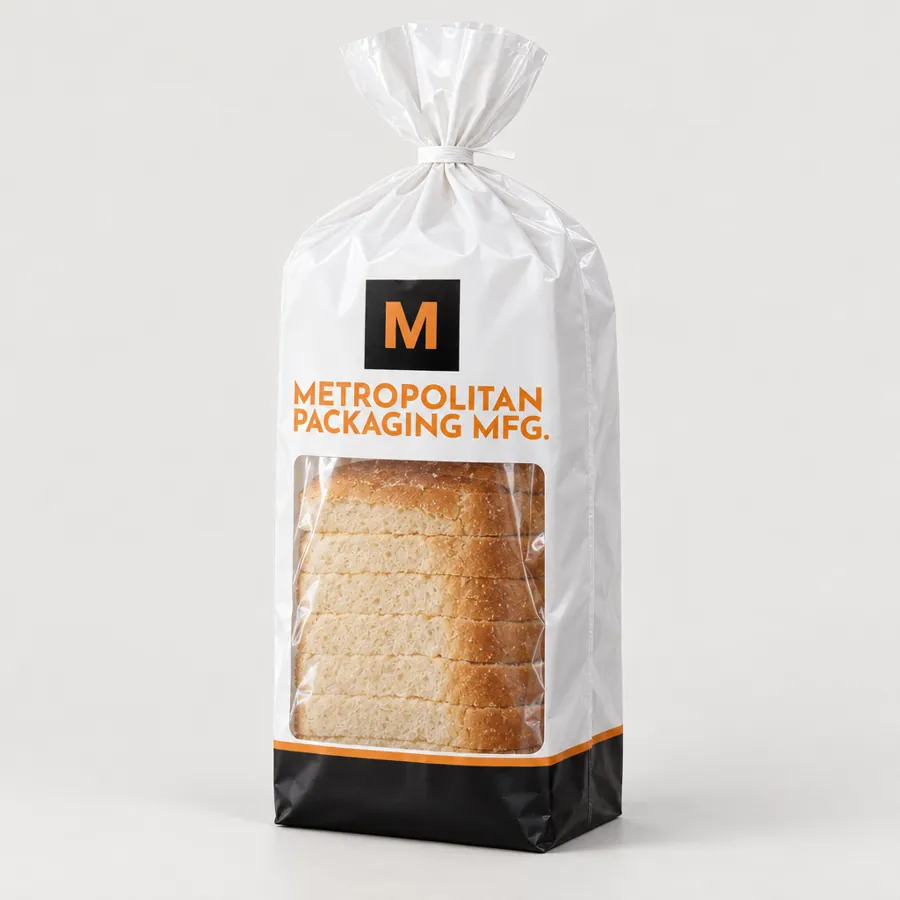
Not sure which style fits? Flat poly bags and pouches cover most everyday products, bottom gusset bags add room for bread and bulky items, and poly mailers handle e-commerce shipping.
Getting started with custom poly bags
Metropolitan Packaging has made custom printed bags in Brooklyn, New York for more than 60 years. Printing and bag making are done in house, on PE and PP films, so one team handles your job from artwork to finished bags.
To get a quote, send us the product you are packing, an approximate bag size, the quantity, the number of print colors and any features you need. Our minimum order is 10,000 for most bags, and 5,000 for stand-up, flat-bottom box and quad-seal pouches. You can request a quote online, call 1-800-642-0165 or email Sales@metropack.com.